

Our Series B, and what it means for you

When we announced our Series A last May, most conversations I had about voice began with someone explaining why they doubted it. That skepticism was natural. People had been trying voice tools for 15 years and getting the same result each time, so the reasonable assumption was that this one would disappoint them too.
I don't have those conversations anymore. People tell me instead how much time they save talking instead of typing and what they want Flow to do next. In a little over a year, voice went from something people were evaluating to something they rely on, and it happened faster than any of us expected.
That shift is why we’ve raised a new round of funding, and more importantly, it’s going to shape everything that comes next. Today we're announcing $280 million in Series B funding at a $2 billion valuation, led by our long-time investor and partner, Menlo Ventures, and returning investor Notable Capital.
New investor PLUS Capital also joined the round, alongside a select group from its collective of artists, athletes, and cultural leaders. This group includes more than 10 actors, directors, and musicians, and more than 10 athletes, including Livvy Dunne, Shaun White, Dak Prescott, DK Metcalf, Joe Burrow, Kyle Hamilton, Aaron Gordon, Alex Caruso, Domantas Sabonis, Klay Thompson, Paul George, and Trae Young.
The round matters less than the problem it's pointed at, and that problem gets harder as more people come to depend on you.
Higher stakes, higher bar
For most of the last decade, talking to a computer meant asking about the weather or setting a timer. Our chief scientist Ariya Rastrow, who was a founding member of the team behind Alexa, has written about how little that list changed in 10 years. The bar was low, but so were the stakes, because nobody was doing anything that mattered to them by voice. If it misheard you, you said it again and moved on.
What people are doing now is different. When voice is how you write important messages and key work documents, a single wrong word costs you something real. You stop, you reach for the keyboard, you fix it, and by the time you look up the thing you were in the middle of thinking is gone. It breaks your flow and it damages your trust in the product. The whole reason to talk instead of type is to stay inside your own train of thought, and a tool that pulls you out of it every few sentences isn't saving you anything.
“The whole reason to talk instead of type is to stay inside your own train of thought.”
So accuracy isn't one feature among several for us. It's what decides whether any of this becomes how people live and work, and it's where the first and largest part of this round is going.
A new model, built for real conditions
Alongside the funding, we're announcing a preview of our first proprietary speech model. Most speech models are trained and evaluated on clean recordings made in a quiet room with a good microphone and an accent the model has heard many times before. Almost nobody lives in those conditions. You're in a car, on a street, or sitting a foot away from someone else's conversation in an open office.
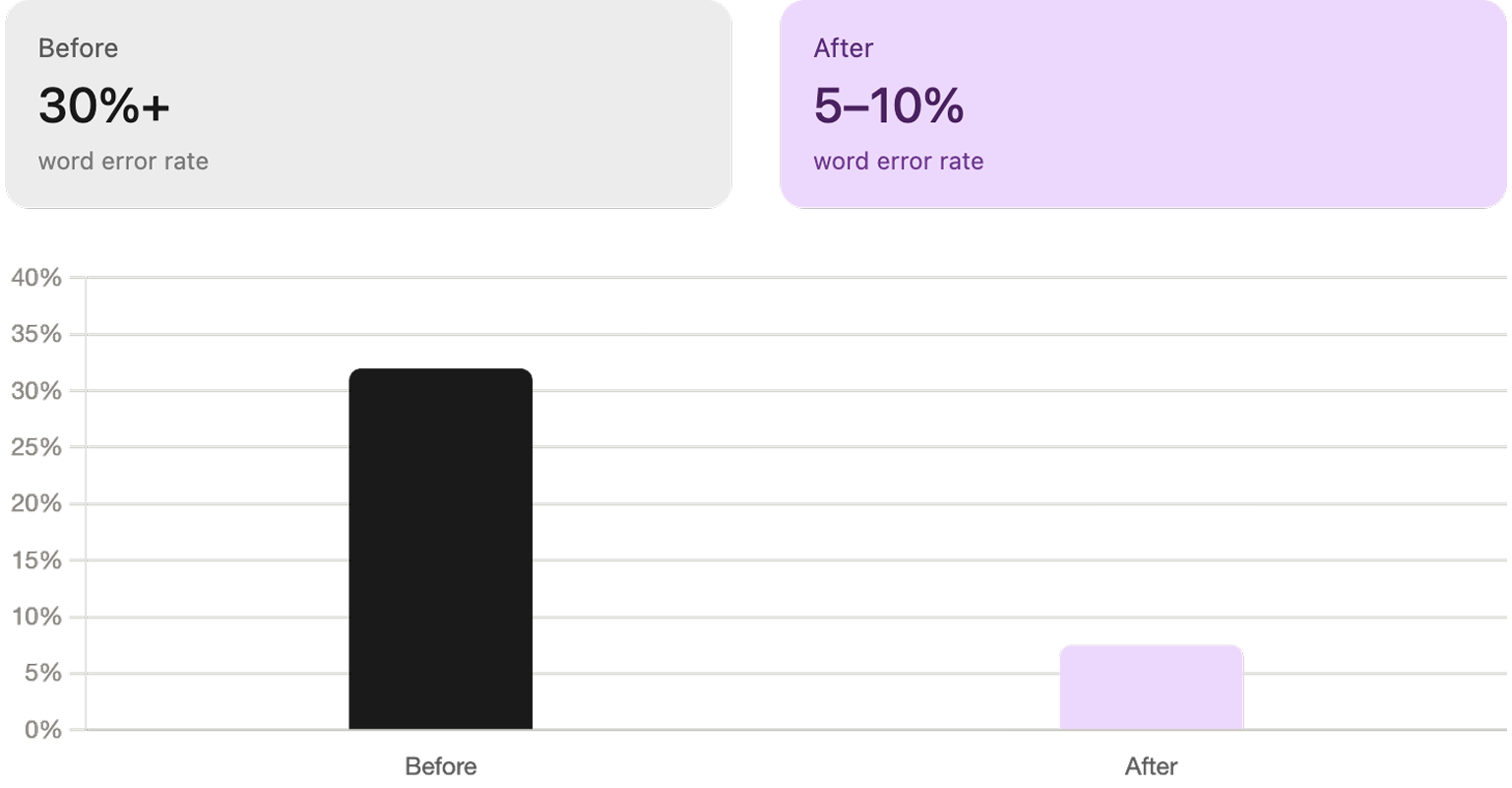
We built this model for where people actually use Flow. In the hardest conditions, with background noise, wind, or music, error rates fall from more than 30% of words to somewhere between 5 and 10%. Across everyday use, we expect it to reduce the number of dictations you need to edit by 30 to 35%.
It's also better at the way people genuinely speak. Roughly half the world moves between languages during a normal day, often inside a single sentence, and models trained on one language at a time handle that badly. Hinglish is a good example of the detail involved. Hindi speakers usually write in Devanagari, but when they're speaking Hinglish they expect it back in romanized script, so hearing every word correctly still isn't enough to give someone something they can send. The same is true of the vocabulary particular to your own life, which is why the model draws on your dictionary and the names of the people around you.
Domantas Sabonis, who joined this round through PLUS Capital, put it this way:"I use Flow every day. I grew up rotating between English, Spanish, and Lithuanian, and it keeps up with me no matter which one I'm speaking. So the opportunity to invest and support a product I use and believe in was a no brainer."
The number we're actually chasing
Internally, we measure ourselves against what we call zero edit rate, which is the share of everything you say that comes back right the first time and needs nothing from you at all. Not close enough to send, and not quick to fix, but genuinely untouched. It's a deliberately unforgiving way to keep score, and it's the standard the next few years of our work are set against.
Most of this round goes there, into the research that closes that gap and the work of getting it everywhere people already talk and type. This model is the start of it rather than the end. It's also why we built the Wispr Advanced Interfaces Lab, which Ariya joined us to lead: the same conviction, carried further out, toward systems that understand what you meant, hold the context of what you're doing, and turn that into an outcome rather than a block of text. Flow is what you say to your computer. Notetaker, which we launched last week to take notes in your meetings, is what you say to everyone else. Both get better as the models underneath them do.
“Systems that understand what you meant, hold the context of what you’re doing, and turn that into an outcome rather than a block of text.”
Sixty billion words in
People have now written more than 60 billion words with Flow. Every one of them was someone deciding, in a small moment, that it was easier to talk than to type.
That’s the whole thing we're accountable for. Not the size of the round or the valuation attached to it, but whether the next word you say comes back the way you meant it. This funding exists to close the distance between those two, and the years ahead of us will be judged on how much of it we close.
Thank you for coming along with us this far. You're the reason the bar keeps moving, and we're not planning to stop raising it.
.jpg)
.png)