

Canto 1: A speech model that gets better with use
Wispr Flow has one goal: let people say anything they want and have it ready to send. For that to work, we have to get two things right.
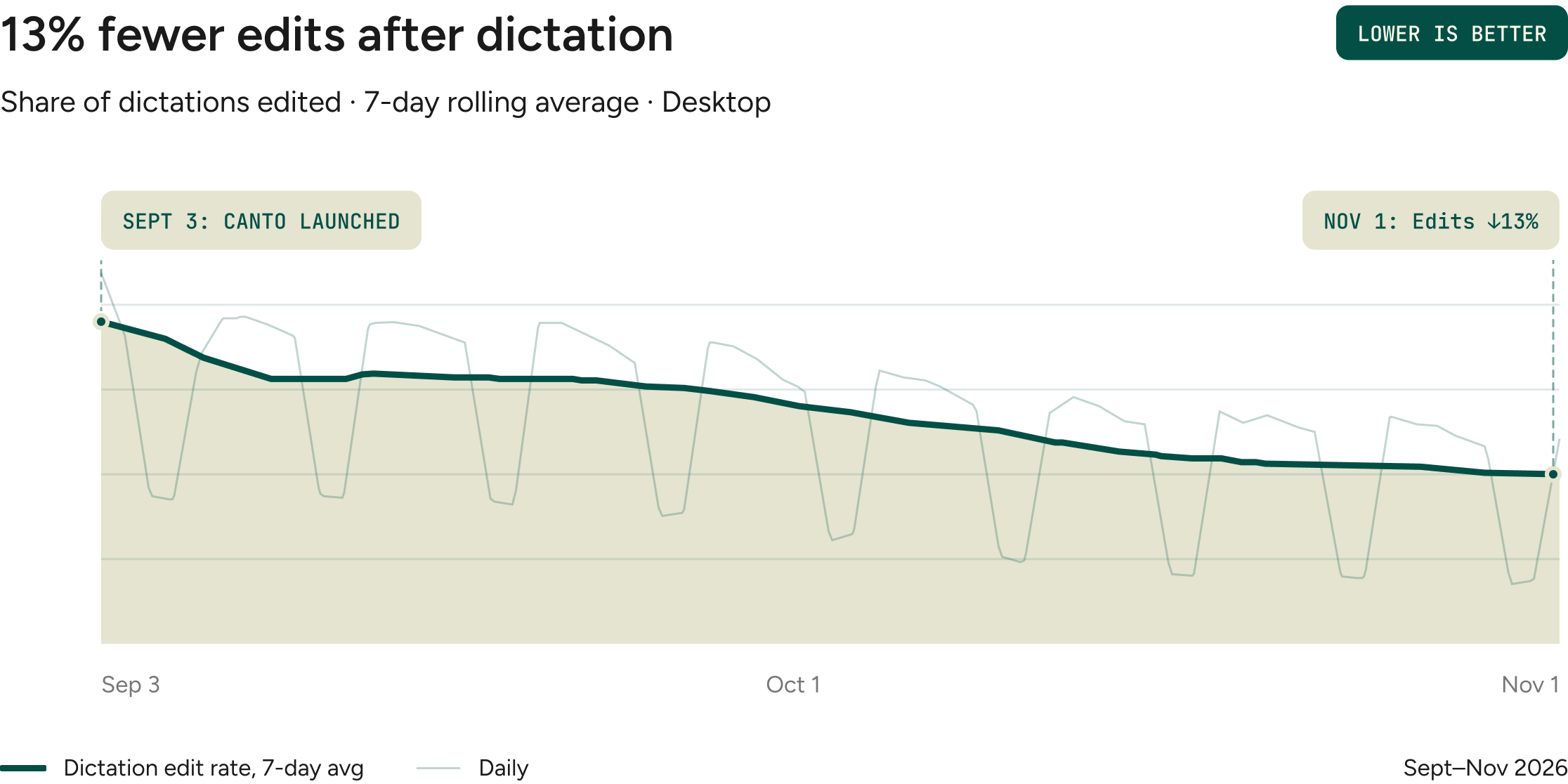
People shouldn’t have to edit. If someone uses Flow 100 times a day, how many times do they need to change anything before hitting send? We measure that as Dictation Edit Rate: the percentage of dictations people edit after the text appears. Our goal is zero. Every time we bring that number down, more writing can go straight from thought to finished message.
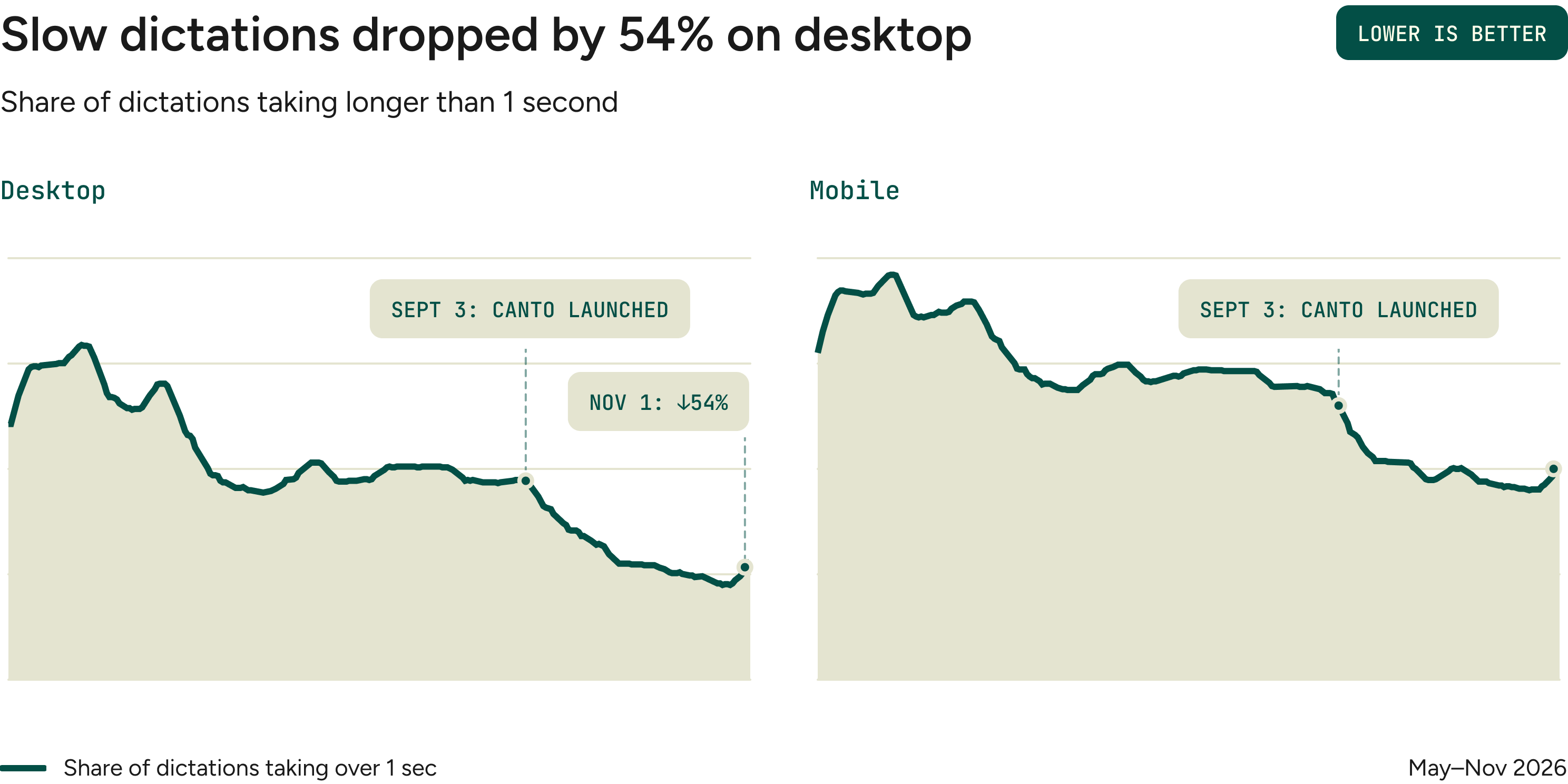
People shouldn’t have to wait. When someone is waiting for a dictation, even a one-second pause is noticeable. An average or median can hide those moments, so we also track the percentage of Flow dictations that take more than one second to appear after someone stops speaking. Bringing that number down means fewer interruptions between saying something and moving on.
In September, the Wispr Advanced Interfaces Lab released Canto 1, our first real-time model trained on how people actually dictate. In addition to improving Dictation Edit Rate and latency, we made it better at using personal context. As Flow learns the names and vocabulary someone uses, Canto 1 can put that knowledge to work more effectively for that user, so the same model can deliver better results over time.
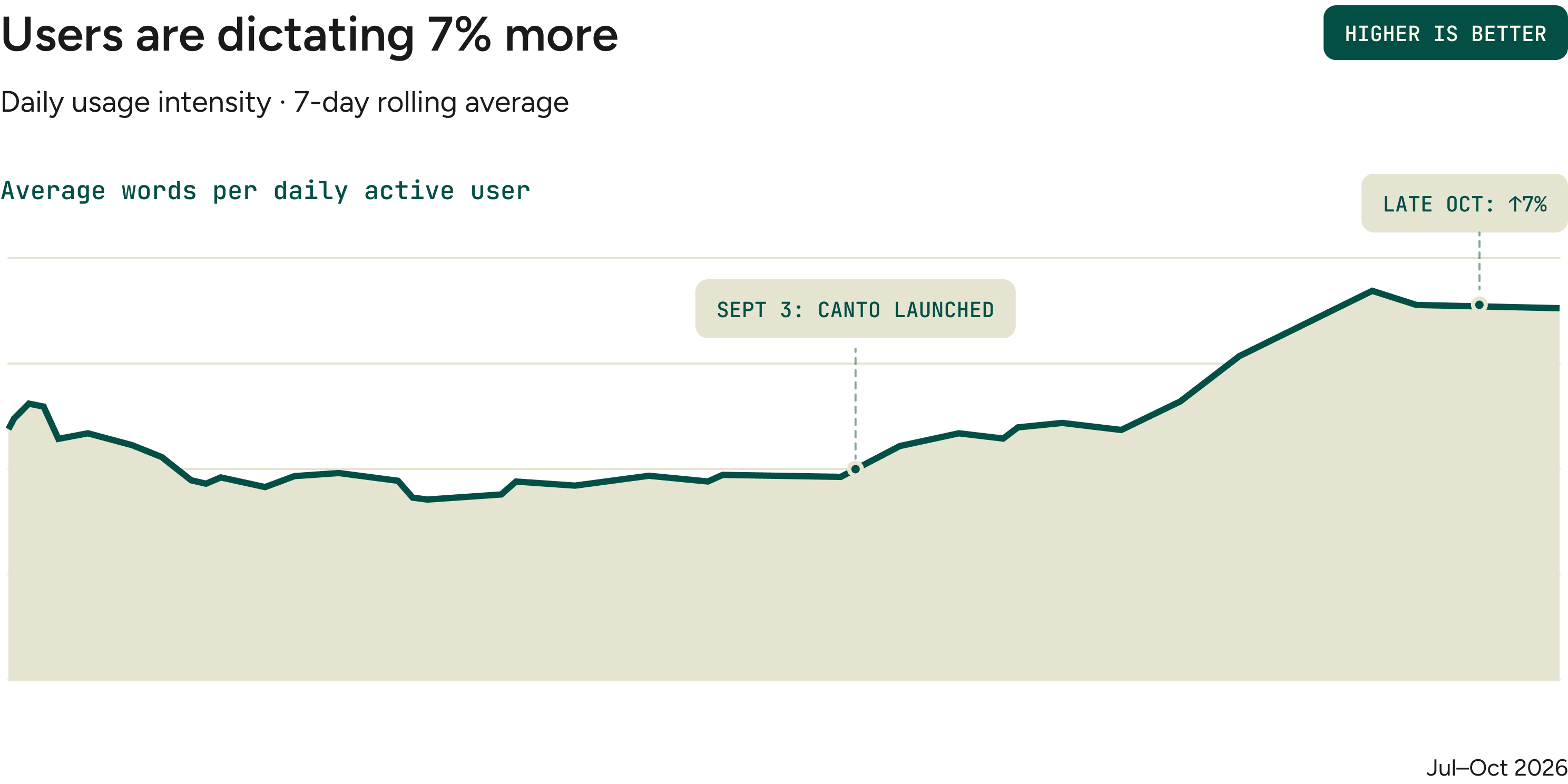
Flow has run on Canto 1 for two months. Desktop users now fix 13% fewer dictations. Slow dictations, the ones that take more than a second to appear, are down 54%. And users dictate 7% more words each day.
At launch, Canto 1 had the lowest word error rate (WER) on real dictations among the models we tested, including models from Google, OpenAI, AssemblyAI and Deepgram.
While WER is a common metric for speech models and it works well in testing, it has two limitations in everyday use: live dictations have no human-written reference transcription to compare against, and the metric treats every error the same.
That's why we focus on what matters most to our users: Dictation Edit Rate. Since Canto 1 launched, the dictation edit rate on desktop has fallen 13%. We post-trained Canto 1 to make better use of personal context. As Flow learns someone’s vocabulary and the names they use through corrections and personal dictionary entries, Canto 1 can use that information effectively in future dictations.
Faster responses from a single model
We hold ourselves to a latency budget of under 700 milliseconds, from the moment a user stops speaking to the moment words appear. That covers speech recognition, formatting, OS latency, and network latency.
Before Canto 1, Flow ran several speech recognizers on each dictation and used the best result. That protected accuracy, but every dictation had to wait for the slowest recognizer to catch up. Before removing the other recognizers, we A/B tested Canto 1 against the prior setup on live dictations to confirm the accuracy held.
Flow was already improving, but Canto 1 was fast and accurate enough to replace the multi-recognizer setup. Since deploying Canto, dictations that take longer than a second to appear have dropped by 54% on desktop and 37% on mobile.
More writing by voice
Fewer edits and faster responses only matter if people change how they work. We track the average number of words each user dictates per day because it shows how much of their writing they are willing to move from the keyboard to voice.
Before Canto 1, usage had held steady for two months. After Canto 1 launched on September 3, it began to rise, and by late October users were dictating 7% more words a day. The increase came gradually over several weeks as trust in Canto 1 built. As fewer dictations needed fixing and responses came back faster, people moved beyond short messages to longer work, such as documents and detailed replies.
The gains reinforce each other. As Flow learns more of a person’s vocabulary, Canto 1 has more useful context to draw on, and better results give people more reason to dictate.
What’s next
Canto 1 was the first model from the Wispr Advanced Interfaces Lab. Its successor is training at more than ten times Canto 1’s scale. It targets the conditions where dictation still breaks most often: noisy rooms, conversations with multiple speakers, and languages beyond English. It will work with the same context Flow builds, and we'll judge it the same way: how often people fix what Flow writes, how long they wait, and how much more they choose to dictate each day.
Changing decades of user behavior requires a product experience that feels as natural as how we work today. By building a lab inside a product company, we’re able to optimize for every part of that experience.
The Wispr Advanced Interfaces Lab is looking for researchers and engineers who want to change how millions of people interact with their computers. If that sounds like you, we are hiring.