
Introducing Wispr Advanced Interfaces Lab

For most of my career, the hard problem in voice AI was intelligence: could machines understand what people meant, reason about it, and reliably act? Foundation models have now crossed the threshold and that question is largely settled. But to understand what that means -- and why it changes everything -- it helps to go back to 2014.

I still vividly remember the launch of Alexa in November of that year. After years of research and development with an incredibly talented team, I watched customers interact with an Echo device 20 or 30 feet away. They would ask about the weather, request a song, or set a timer and receive a response instantly. It felt magical. For the first time, voice interaction had escaped the lab and become a mainstream consumer experience. For many of us who had spent our careers working on voice AI and spoken language systems, it felt like the future had finally arrived.

But over time, we learned something important. The utility remained surprisingly narrow. A decade later, the top use cases for voice assistants across the industry are still the same: weather, music, timers, reminders, news. The dream was bigger than the reality. The bottleneck wasn't speech recognition. It was intelligence: the system couldn't understand what people actually wanted, only what they literally said.

That lesson stayed with me. My work on speech recognition started with my PhD at Johns Hopkins, when voice AI still felt like science fiction. In 2012, I joined Amazon as a founding member of the team behind Alexa and Echo, a moonshot that reached hundreds of millions of people and became one of the defining consumer AI experiences of the decade.  I helped build and led a team of ~400 researchers and engineers to get us there. More recently at Meta, I led work on next-generation voice and multimodal foundation models for wearables and smart glasses. Through all of it, I've carried the same belief: once intelligence, memory, reasoning, and action fulfillment catch up, we can finally build the interfaces we originally dreamed about.

AI is an interface problem now.
Ariya Rastrow
CSO, Wispr Flow

For many users, the bottleneck is no longer the intelligence sitting in the backend. It's the interface between humans and that intelligence. Wispr's CTO Sahaj Garg has written about this extensively.

AI is an interface problem now. Solving it means moving beyond transcription and conversation toward systems that understand intent, generate dynamic interfaces, and route intelligence across any model or modality. That's the problem Wispr is built to solve and why I have decided to join the company. Together we're building Wispr Advanced Interfaces Lab dedicated to unlocking truly seamless human-AI interaction.

Voice AI is a crowded space, but most companies are approaching it the same way: voice in, voice out. It makes for compelling demos, but falls short on real-world utility. Wispr has taken a different path: starting with something that works, dictation, and building up from there toward systems that route intelligence, generate interfaces, and understand context across everything you do.

Wispr’s advantage here is structural: unlike systems built around a single model or modality, Wispr is positioned to sit above the entire stack. Different models excel at different tasks, and the landscape is evolving too quickly for any one model to be the answer for everything. Wispr is model-agnostic by design. Our goal is an intelligence layer that routes users to the best backend model, tool, or service for the task at hand, optimizing for quality, latency, cost, and user experience, without requiring users to think about the complexity underneath.
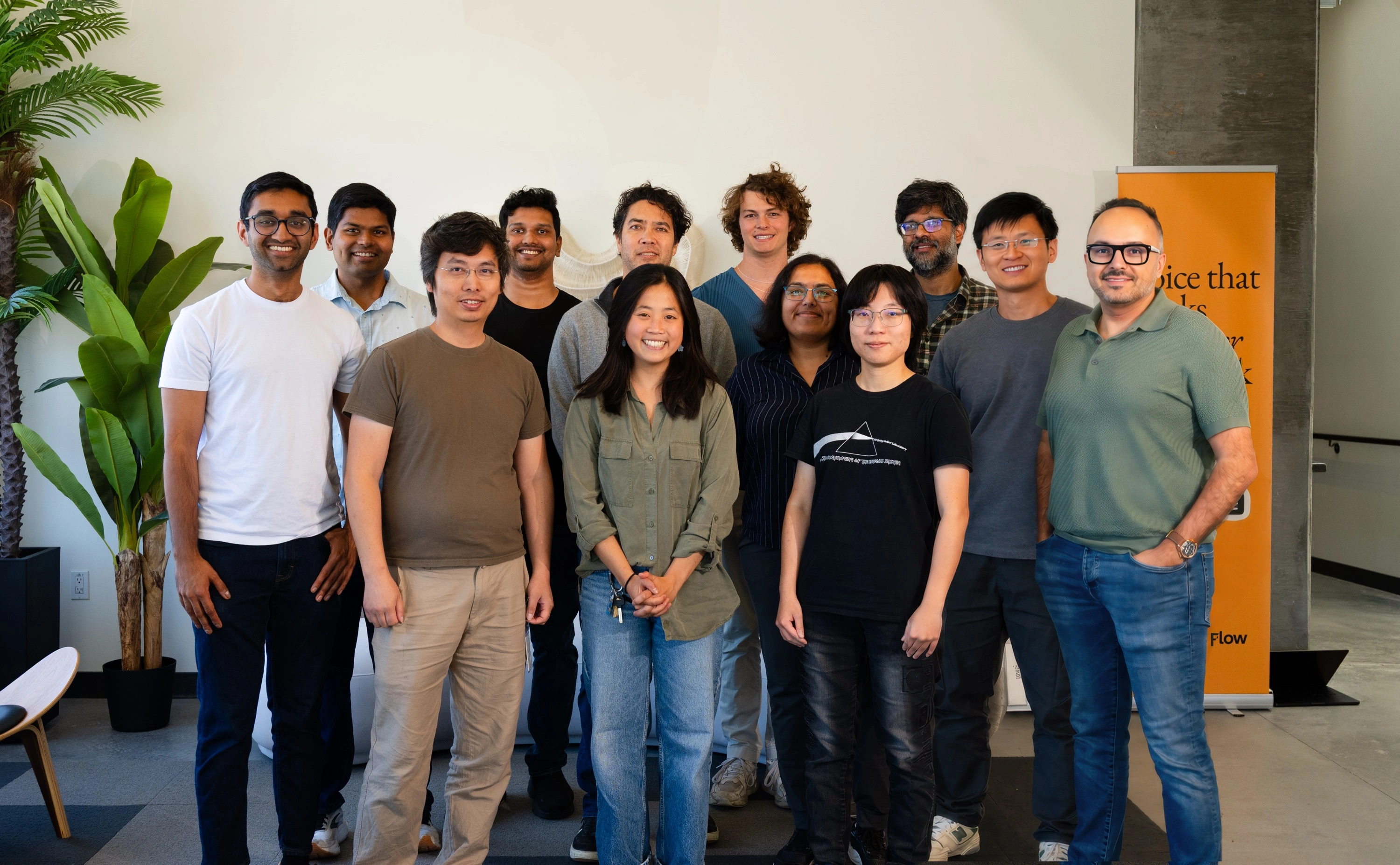
The Wispr ML team in San Francisco last month.

Voice to UI, not voice to voice

Most current voice systems are built around the same basic architecture:

Speech → Text → Intelligence → Text → Speech

While this was the right abstraction for the last decade, we believe it is the wrong one for the next.

Human communication is deeply contextual. Meaning doesn't come solely from the audio signal. It comes from memory, intent, the application you're using, the document you're editing, the people you're interacting with, and the task you're trying to accomplish. The next generation of voice systems will need to understand speech in the context of a user's digital world, not just the audio stream itself. More importantly, they must move beyond recognizing words and generating responses. They must understand intent, translate natural language instructions into executable actions, and reliably fulfill those instructions on behalf of the user. The research frontier is shifting from audio-centric decoding toward context-aware, memory-driven intent understanding and action fulfillment.

The output layer needs to change too. Today's systems are largely optimized to generate conversational outputs like text on a screen or speech through a speaker. We believe future systems will generate the optimal experience for the task at hand, whether that’s a spoken response, a text, an action executed on your behalf, an entire workflow, or even a dynamically generated interface.

Imagine you're debugging a production issue. Rather than navigating dashboards, logs, incident reports, and internal documentation separately, you say: "Show me what changed in the last 24 hours that could explain this latency spike." The system automatically gathers telemetry, identifies relevant code changes, correlates logs and alerts, and presents an interactive investigation workspace. A timeline of relevant deployments appears alongside latency graphs, correlated alerts are highlighted automatically, suspected root causes are ranked by confidence, and supporting evidence can be expanded inline. The AI constructs a debugging environment optimized for the problem at hand, rather than forcing the user to navigate multiple disconnected tools.

The goal isn't for AI to talk back to you. It's to understand intent and generate the right interface for the job. Humans speak 4-5x faster than they type, and that speed of intent should translate directly into outcomes.

Why Wispr

Sahaj and Tanay are both engineers and builders. Tanay has an obsession with product experience. He knows every detail, every design decision, the reasoning behind virtually every pixel in Wispr Flow's interface. Sahaj understands every layer of the stack, from infrastructure and systems to models, product architecture, and long-term technical strategy. That combination of technical depth and first-principles thinking is exactly what I've always looked for in a technical partner. Wispr Advanced Interfaces Lab sits at the exact intersection of everything I've loved working on.

Together, we're building the team, the science, and the foundational technologies to unlock truly seamless human-AI interaction, starting with voice and extending to every modality that follows. Voice is only the beginning. The future will be inherently multimodal. The best systems will understand not only what we say, but what we see, what we're working on, and the broader context surrounding our actions. The future interface layer will seamlessly combine voice, vision, memory, context, and generative UI to help users express intent naturally and achieve outcomes with minimal friction.

If you're excited about solving these problems and want to help build the future of human-computer interaction, we'd love to hear from you. The hardest and most exciting problems are still in front of us.


Share this
24.07.2026 • Product • 4 mins

Introducing Wispr Advanced Interfaces Lab

Ariya Rastrow, CSO, Wispr Flow

For most of my career, the hard problem in voice AI was intelligence: could machines understand what people meant, reason about it, and reliably act? Foundation models have now crossed the threshold and that question is largely settled. But to understand what that means -- and why it changes everything -- it helps to go back to 2014.

I still vividly remember the launch of Alexa in November of that year. After years of research and development with an incredibly talented team, I watched customers interact with an Echo device 20 or 30 feet away. They would ask about the weather, request a song, or set a timer and receive a response instantly. It felt magical. For the first time, voice interaction had escaped the lab and become a mainstream consumer experience. For many of us who had spent our careers working on voice AI and spoken language systems, it felt like the future had finally arrived.

But over time, we learned something important. The utility remained surprisingly narrow. A decade later, the top use cases for voice assistants across the industry are still the same: weather, music, timers, reminders, news. The dream was bigger than the reality. The bottleneck wasn't speech recognition. It was intelligence: the system couldn't understand what people actually wanted, only what they literally said.

That lesson stayed with me. My work on speech recognition started with my PhD at Johns Hopkins, when voice AI still felt like science fiction. In 2012, I joined Amazon as a founding member of the team behind Alexa and Echo, a moonshot that reached hundreds of millions of people and became one of the defining consumer AI experiences of the decade.  I helped build and led a team of ~400 researchers and engineers to get us there. More recently at Meta, I led work on next-generation voice and multimodal foundation models for wearables and smart glasses. Through all of it, I've carried the same belief: once intelligence, memory, reasoning, and action fulfillment catch up, we can finally build the interfaces we originally dreamed about.

AI is an interface problem now.
Ariya Rastrow
CSO, Wispr Flow

For many users, the bottleneck is no longer the intelligence sitting in the backend. It's the interface between humans and that intelligence. Wispr's CTO Sahaj Garg has written about this extensively.

AI is an interface problem now. Solving it means moving beyond transcription and conversation toward systems that understand intent, generate dynamic interfaces, and route intelligence across any model or modality. That's the problem Wispr is built to solve and why I have decided to join the company. Together we're building Wispr Advanced Interfaces Lab dedicated to unlocking truly seamless human-AI interaction.

Voice AI is a crowded space, but most companies are approaching it the same way: voice in, voice out. It makes for compelling demos, but falls short on real-world utility. Wispr has taken a different path: starting with something that works, dictation, and building up from there toward systems that route intelligence, generate interfaces, and understand context across everything you do.

Wispr’s advantage here is structural: unlike systems built around a single model or modality, Wispr is positioned to sit above the entire stack. Different models excel at different tasks, and the landscape is evolving too quickly for any one model to be the answer for everything. Wispr is model-agnostic by design. Our goal is an intelligence layer that routes users to the best backend model, tool, or service for the task at hand, optimizing for quality, latency, cost, and user experience, without requiring users to think about the complexity underneath.

The Wispr ML team in San Francisco last month.

Voice to UI, not voice to voice

Most current voice systems are built around the same basic architecture:

Speech → Text → Intelligence → Text → Speech

While this was the right abstraction for the last decade, we believe it is the wrong one for the next.

Human communication is deeply contextual. Meaning doesn't come solely from the audio signal. It comes from memory, intent, the application you're using, the document you're editing, the people you're interacting with, and the task you're trying to accomplish. The next generation of voice systems will need to understand speech in the context of a user's digital world, not just the audio stream itself. More importantly, they must move beyond recognizing words and generating responses. They must understand intent, translate natural language instructions into executable actions, and reliably fulfill those instructions on behalf of the user. The research frontier is shifting from audio-centric decoding toward context-aware, memory-driven intent understanding and action fulfillment.

The output layer needs to change too. Today's systems are largely optimized to generate conversational outputs like text on a screen or speech through a speaker. We believe future systems will generate the optimal experience for the task at hand, whether that’s a spoken response, a text, an action executed on your behalf, an entire workflow, or even a dynamically generated interface.

Imagine you're debugging a production issue. Rather than navigating dashboards, logs, incident reports, and internal documentation separately, you say: "Show me what changed in the last 24 hours that could explain this latency spike." The system automatically gathers telemetry, identifies relevant code changes, correlates logs and alerts, and presents an interactive investigation workspace. A timeline of relevant deployments appears alongside latency graphs, correlated alerts are highlighted automatically, suspected root causes are ranked by confidence, and supporting evidence can be expanded inline. The AI constructs a debugging environment optimized for the problem at hand, rather than forcing the user to navigate multiple disconnected tools.

The goal isn't for AI to talk back to you. It's to understand intent and generate the right interface for the job. Humans speak 4-5x faster than they type, and that speed of intent should translate directly into outcomes.

Why Wispr

Sahaj and Tanay are both engineers and builders. Tanay has an obsession with product experience. He knows every detail, every design decision, the reasoning behind virtually every pixel in Wispr Flow's interface. Sahaj understands every layer of the stack, from infrastructure and systems to models, product architecture, and long-term technical strategy. That combination of technical depth and first-principles thinking is exactly what I've always looked for in a technical partner. Wispr Advanced Interfaces Lab sits at the exact intersection of everything I've loved working on.

Together, we're building the team, the science, and the foundational technologies to unlock truly seamless human-AI interaction, starting with voice and extending to every modality that follows. Voice is only the beginning. The future will be inherently multimodal. The best systems will understand not only what we say, but what we see, what we're working on, and the broader context surrounding our actions. The future interface layer will seamlessly combine voice, vision, memory, context, and generative UI to help users express intent naturally and achieve outcomes with minimal friction.

If you're excited about solving these problems and want to help build the future of human-computer interaction, we'd love to hear from you. The hardest and most exciting problems are still in front of us.

Check out our latest articles

Why supporting 100 languages is hard

At Wispr Flow, we’re building toward that goal: natural, accurate voice-to-text in 100+ languages. It may sound simple, but it’s one of the hardest technical challenges in AI.

19.01.2026 • Insights

Fundamental challenges in speech recognition research

Explore real examples of speech recognition errors, why ASR struggles, and how Wispr is rethinking transcription with context-aware AI.

17.09.2025 • Insights

Technical challenges behind building Wispr Flow

Flow is built on solving tough challenges — from speed and accuracy to new ways of using voice. Here’s what it takes to make voice feel natural.

26.09.2025 • Product

Help build the interface between humans and intelligence.